

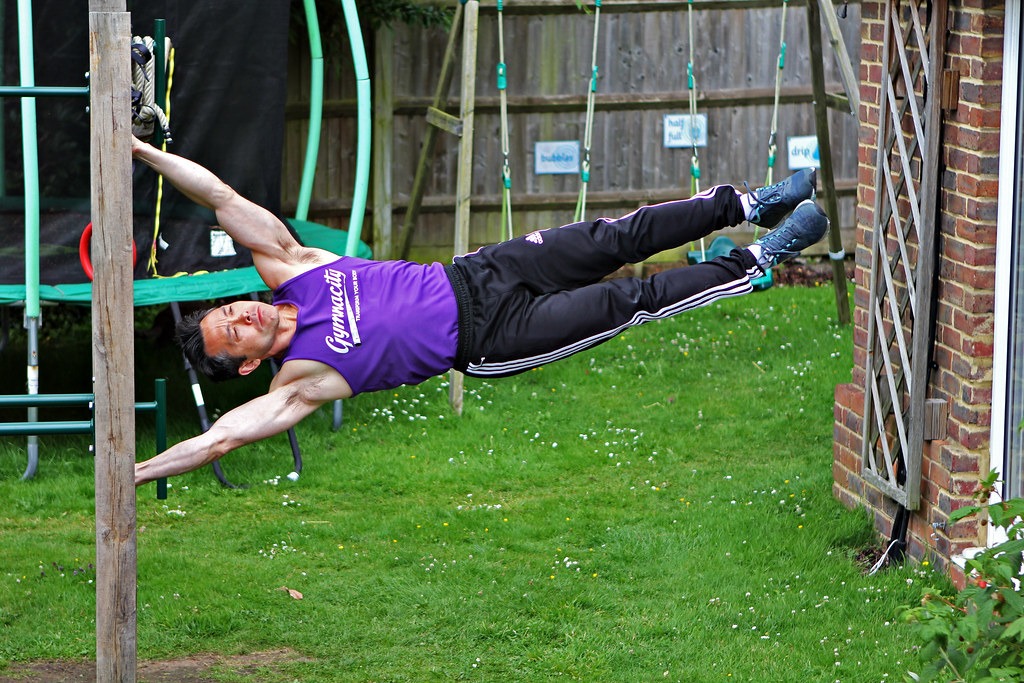
You do not need a barbell to build serious strength and muscle. Calisthenics uses your own body weight, and with the right progressions it can challenge even strong lifters. It is cheap, works anywhere and builds impressive control and joint resilience. The key is applying progressive overload without plates.
- Muscle grows from hard sets close to failure, whether the load is a barbell or your body.
- Progress comes from harder variations, more reps, slower tempos and added weight.
- Push-ups, pull-ups, dips, rows, squats and hinges form the core.
- Lower-body progression is the hardest part of calisthenics; single-leg work solves it.
Can bodyweight training build muscle?
Yes. Studies comparing push-ups with bench press at matched effort found similar gains in chest size and strength. The muscle responds to tension and effort, not to the kind of equipment. The challenge is keeping the exercise hard enough as you get stronger.
How to progress without weights
- Harder variations: move from knee push-ups to standard, then archer and one-arm progressions.
- More reps and sets, up to about 20 to 30 reps before moving to a harder variation.
- Slower tempo: three to five seconds on the lowering phase increases difficulty.
- Pauses: holding the hardest position adds tension.
- Leverage: elevating feet or changing body angle shifts more load.
- Added weight: a backpack, weighted vest or dip belt.
Core movements and progressions
| Pattern | Easier | Harder |
|---|---|---|
| Horizontal push | Incline push-up | Archer, pseudo-planche push-up |
| Vertical push | Pike push-up | Elevated pike, handstand push-up |
| Horizontal pull | High inverted row | Low row, one-arm row |
| Vertical pull | Band-assisted pull-up | Weighted, archer pull-up |
| Squat | Bodyweight squat | Bulgarian split squat, pistol squat |
| Hinge | Glute bridge | Single-leg hip thrust, Nordic curl |
Programming
Training three or four times a week with full-body or upper-lower sessions works well. For each movement, do three to four sets in a challenging rep range, leaving one to three reps in reserve. When you can do the top of the range for all sets, progress to a harder variation. Track your sets the same way you would with weights.
Strengths of calisthenics
It builds body control, shoulder stability and grip strength, needs almost no equipment and is easy on the budget. Many people find it kinder to joints than heavy barbell work, as long as progressions are gradual.
Common mistakes
- Doing endless easy reps instead of progressing to harder variations.
- Neglecting legs; bodyweight squats alone stop challenging most people quickly.
- Rushing advanced skills such as planches, which stress wrists, elbows and shoulders.
- Poor form under fatigue, especially on dips and pull-ups.
Many lifters mix calisthenics with weights: weighted pull-ups and dips with barbell squats and deadlifts is a classic, effective combination.
A sample week
- Day 1, upper: pull-ups, dips, inverted rows, pike push-ups, 3 to 4 sets each.
- Day 2, lower: Bulgarian split squats, single-leg hip thrusts, Nordic curls, calf raises.
- Day 3: rest or easy cardio.
- Day 4, upper: push-up variation, chin-ups, archer rows, hanging knee raises.
- Day 5, lower: pistol squat progressions, step-ups, glute bridges, planks.
A doorway pull-up bar, a pair of gymnastic rings and a sturdy bench cover almost everything above.
Nutrition still matters
Muscle growth needs enough protein and energy whatever the training style. See natural muscle building.
Training and recoveryBuilding a home gym in CanadaRead guide
Frequently asked questions
Can calisthenics build big muscles?
Yes, with progressive overload and enough food. Legs are the hardest to progress without added weight.
How many push-ups should I be able to do before progressing?
When you can do about 20 to 30 good reps for several sets, move to a harder variation.
Are pull-ups better than lat pulldowns?
Both work. Pull-ups add core and grip demand; pulldowns make loads easier to adjust.
Educational information only. Nothing here is medical advice or a recommendation to use any product. Anabolic steroids are Schedule IV under the Controlled Drugs and Substances Act. Talk to a doctor and get bloodwork before and after using any compound.