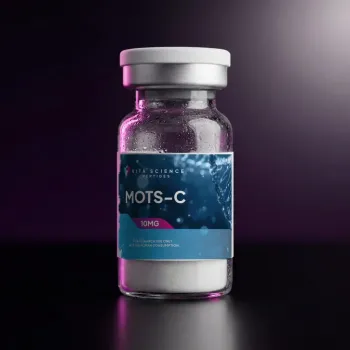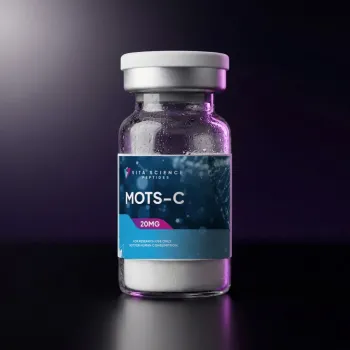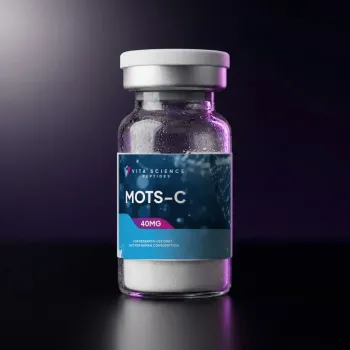



Most of the peptides people talk about are copies of hormones made by the brain or the gut. MOTS-c is different: it is coded by the small ring of DNA inside your mitochondria, the structures that turn food into usable energy. Since its discovery in 2015 it has become one of the most studied “exercise signal” molecules in metabolism research. This guide explains what it is, what the studies actually found and where the evidence stops.
- MOTS-c is a 16-amino-acid peptide encoded in mitochondrial DNA, first described by researchers at the University of Southern California in 2015.
- In mice it improved insulin sensitivity, limited weight gain on high-fat diets and extended running capacity, especially in older animals.
- Blood levels rise during exercise and tend to fall with age, which is why it is studied as an ageing and metabolism signal.
- No MOTS-c product is approved by Health Canada or any other regulator. Human data are limited to small studies and one discontinued drug programme.
Where MOTS-c comes from
Mitochondria carry their own short loop of DNA, about 16,500 base pairs long, inherited from your mother. For decades scientists assumed it held only 37 genes, all for energy production. In 2015 a team led by Changhan Lee found a short open reading frame hidden inside one of those genes, the 12S ribosomal RNA. It codes for a 16-amino-acid peptide they named MOTS-c, short for “mitochondrial open reading frame of the 12S rRNA type-c”.
That discovery mattered because it showed mitochondria do not just burn fuel. They also send signals to the rest of the cell, and to other tissues through the bloodstream. MOTS-c belongs to a small family of these “mitochondrial-derived peptides”, alongside humanin and the SHLP peptides.
What it does in the cell
Most of what is known comes from cell and mouse work. The main findings line up into a fairly clear picture:
| Finding | What it means |
|---|---|
| Acts mainly in skeletal muscle | Muscle is the main target tissue in animal studies, which is why exercise links keep coming up. |
| Activates AMPK | AMPK is the cell’s fuel gauge. When it is switched on, cells take up more glucose and burn more fat, the same pathway exercise and the diabetes drug metformin act on. |
| Interrupts the folate cycle | This causes a build-up of AICAR, a natural AMPK activator, which is the proposed route to the effect above. |
| Moves into the nucleus under stress | A 2018 study showed MOTS-c travels to the nucleus during metabolic stress and switches on protective antioxidant genes. |
The mouse studies
Diet and insulin resistance
In the original 2015 paper, mice on a high-fat diet that received MOTS-c gained less weight and stayed more insulin sensitive than untreated mice on the same diet. Food intake did not explain the difference, which pointed to a change in how muscle handled glucose.
Physical capacity in older animals
A 2021 study in Nature Communications (Reynolds and colleagues) treated young, middle-aged and old mice. Treated animals ran longer and further on treadmill tests, and the oldest mice showed the clearest improvement in grip strength, gait and endurance. The same paper reported that circulating MOTS-c in healthy young men roughly doubled during a bout of cycling and stayed raised afterwards.
Mice clear peptides fast, receive doses scaled very differently to humans and live in controlled conditions. Many metabolic findings that look strong in rodents shrink or vanish in people. Treat these studies as reasons for more research, not as predictions of what a person would experience.
What we know in humans
Human evidence is thin and mostly indirect:
- Blood levels and age. Several studies find lower circulating MOTS-c in older adults and in people with obesity or type 2 diabetes, though results are not consistent across groups.
- A genetic variant. A variant in the MOTS-c sequence (m.1382A>C), common in parts of Northeast Asia, has been linked with longevity in one Japanese cohort and with type 2 diabetes risk in men in another. Association is not proof of cause.
- A drug programme that stopped. The biotech company CohBar developed CB4211, a modified MOTS-c analogue, and ran an early-stage trial in people with fatty liver disease and obesity. The changes were modest and the company wound down its pipeline in 2023, so no approved MOTS-c medicine exists.
Exercise is the proven way to raise it
The most reliable finding across studies is that hard exercise raises MOTS-c in muscle and blood. That is useful context. Much of what MOTS-c does in mice, such as better glucose uptake, AMPK activation and improved endurance, is what consistent training already delivers in people. Resistance training two to four times a week, regular aerobic work and enough sleep remain the foundation, with or without any research compound.
Research peptide, shipped from VancouverVita Science MOTS-c 10 mgView product
Handling a lyophilised research peptide
MOTS-c is supplied as a freeze-dried powder. Unopened vials keep best in a fridge, away from light. Once mixed with bacteriostatic water, peptides break down faster and should stay refrigerated. Never shake a vial hard; swirl it gently. Use a new sterile syringe every time and label vials with the date they were mixed.
Legal status in Canada
MOTS-c is not listed in the Controlled Drugs and Substances Act, and it is not an approved drug in Canada, so it cannot be sold as a treatment for any condition. It is sold for laboratory research. Athletes should know that the World Anti-Doping Agency’s prohibited list bans unapproved substances and metabolic modulators in sport, so tested competitors should not touch it.
Frequently asked questions
Is MOTS-c a growth hormone peptide?
No. It does not act on the pituitary or raise growth hormone. Its studied effects are metabolic, mainly on how muscle uses glucose and fat.
Has MOTS-c been tested in proper human trials?
Only in small, early studies, including a modified analogue that did not go on to approval. There are no large, long-term human trials of the peptide itself.
Does exercise really raise MOTS-c?
Yes. Studies in healthy adults found blood levels rise during and after vigorous exercise, which is one reason researchers call it an exercise-related signal.
How should the powder be stored?
Keep unopened vials cold and dark. After mixing, keep the vial in the fridge and use it within the time the supplier recommends.
Educational information only. Nothing here is medical advice or a recommendation to use any product. Anabolic steroids are Schedule IV under the Controlled Drugs and Substances Act. Talk to a doctor and get bloodwork before and after using any compound.