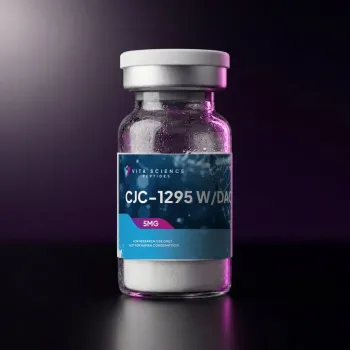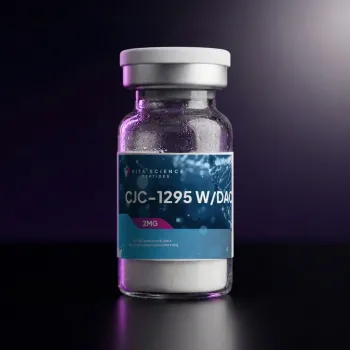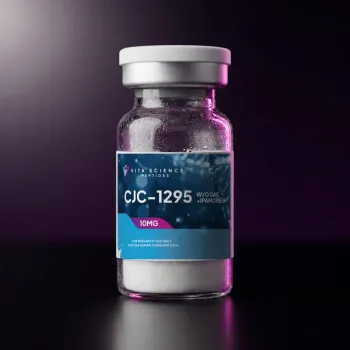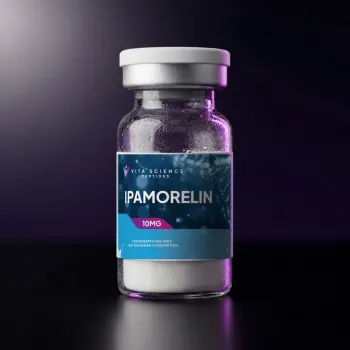


CJC-1295 is sold in two versions that share a name but behave very differently. One clears from the blood in about half an hour; the other lasts close to a week. The difference comes down to a small chemical add-on called DAC. This guide explains what each version is, what the human research found and why the timing of growth hormone release is the real point of contention.
- Both versions are modified copies of the first 29 amino acids of GHRH, the brain’s growth-hormone-releasing hormone.
- “Without DAC”, often called modified GRF 1-29, lasts about 30 minutes and produces a short pulse of growth hormone.
- “With DAC” binds to albumin in the blood, which stretches its half-life to roughly six to eight days and keeps growth hormone raised continuously.
- Neither version is approved as a medicine. The DAC version reached early human trials before development stopped.
Where CJC-1295 comes from
The hypothalamus releases GHRH in bursts, which tell the pituitary to release growth hormone. Natural GHRH breaks down in a few minutes. Researchers found that only its first 29 amino acids are needed for activity, and that swapping four of them makes the chain much harder for enzymes to cut. That tetrasubstituted fragment is the base of both CJC-1295 products.
The Canadian biotech company ConjuChem then added the drug affinity complex, or DAC: a reactive linker that latches onto albumin, the most common protein in blood. Albumin lives for weeks, so the peptide rides along with it.
The two versions side by side
| Without DAC (mod GRF 1-29) | With DAC | |
|---|---|---|
| Half-life | About 30 minutes | About 6 to 8 days |
| Growth hormone pattern | A sharp pulse after each injection, then back to baseline | Continuously raised baseline, smaller natural pulses on top |
| IGF-1 effect | Modest, depends on frequency | Raised for one to two weeks after a single injection in trials |
| Common pairing | Usually combined with a ghrelin-type peptide such as ipamorelin | Usually used alone |
| Human data | Very limited | Small phase 1 and 2 studies |
What the human research found
In a 2006 study in healthy adults, published in the Journal of Clinical Endocrinology and Metabolism, a single injection of CJC-1295 with DAC raised average growth hormone two- to ten-fold for six days or more, and IGF-1 one-and-a-half to three-fold for up to eleven days. Repeated weekly or every-other-week injections kept IGF-1 raised. Side effects were mostly mild: flushing, injection-site reactions and headache.
A follow-up study showed that despite the steady elevation, the pituitary still produced its own pulses on top. ConjuChem moved into a trial in people with HIV-related fat redistribution, which was halted in 2006 after a participant died; investigators considered the death unrelated, but the programme did not resume.
Growth hormone is naturally released in pulses, mostly during deep sleep. Tissues such as the liver and muscle respond differently to pulses than to a constant level, and some researchers think steady elevation increases water retention and insulin resistance. That is the main argument for the short version, used to mimic pulses, and the main open question about the DAC version.
Why the short version is paired with ipamorelin
GHRH and ghrelin act on different pituitary receptors. Activating both at once produces a much bigger growth hormone pulse than either alone, a synergy shown in older studies with natural hormones. Ipamorelin is a ghrelin-receptor peptide that raises growth hormone with little effect on cortisol or prolactin, which is why it is the usual partner for CJC-1295 without DAC in research protocols.
Research peptide, shipped from VancouverVita Science CJC-1295 Without DAC 10 mgView product
Possible side effects
- Flushing and warmth shortly after injection.
- Redness, itching or a small lump at the injection site.
- Water retention, tingling hands or joint aches if growth hormone stays high.
- Higher fasting blood sugar with prolonged elevation.
- Headache and light-headedness in some people.
Anyone with active cancer, diabetes or uncontrolled blood pressure should treat any growth hormone secretagogue as off limits.
Handling and storage
Both versions come as freeze-dried powder. Keep unopened vials cold and dark, mix them gently with bacteriostatic water and keep mixed vials refrigerated. Label each vial with the version and the date; the names look alike but the products are not interchangeable.
Legal status
CJC-1295 is not an approved drug in Canada and is not listed in the Controlled Drugs and Substances Act. It is sold for research. Growth-hormone-releasing factors are banned at all times under the World Anti-Doping Code.
Frequently asked questions
Is “Mod GRF 1-29” the same as CJC-1295?
Mod GRF 1-29 is CJC-1295 without DAC. Sellers use both names for the same tetrasubstituted peptide.
Which version raises IGF-1 more?
The DAC version, because it keeps growth hormone raised around the clock. Whether that is desirable is debated.
Can the two versions be swapped?
No. Their timing is completely different, so they are not interchangeable in any protocol or study design.
Does CJC-1295 suppress natural growth hormone?
Studies with the DAC version found natural pulses continued. Long-term effects on the pituitary have not been studied.
Educational information only. Nothing here is medical advice or a recommendation to use any product. Anabolic steroids are Schedule IV under the Controlled Drugs and Substances Act. Talk to a doctor and get bloodwork before and after using any compound.